


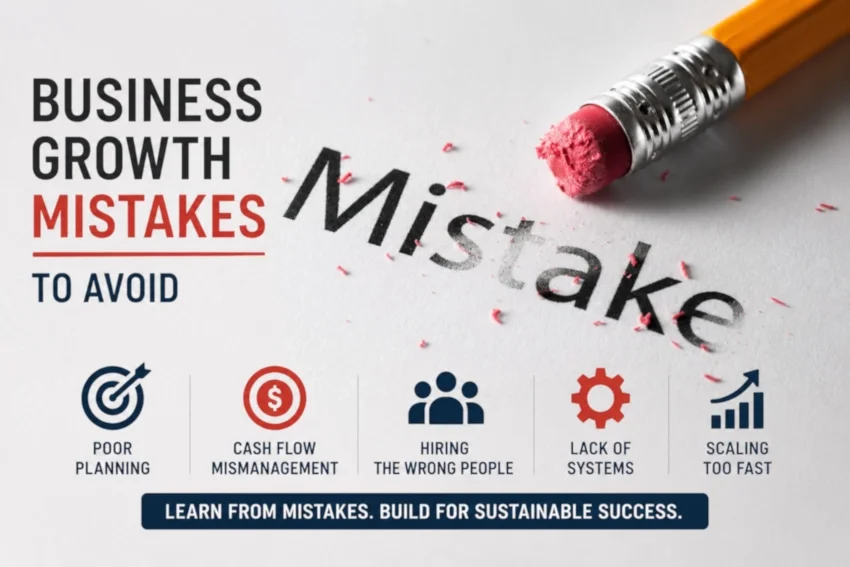
Growing a business is an exciting achievement, but expansion often comes with new challenges. While many organizations focus on increasing revenue and attracting new customers, they sometimes overlook the factors that support sustainable growth. As a result, even successful businesses can encounter obstacles that slow progress and reduce profitability.
Many companies make avoidable business growth mistakes that create operational inefficiencies, customer dissatisfaction, and financial strain. Understanding these common errors can help business owners develop smarter strategies and build stronger foundations for long-term success.
Growth should not only be about becoming bigger. Instead, it should focus on becoming stronger, more efficient, and better prepared for future opportunities.
Why Growth Challenges Are Common
Business expansion introduces new responsibilities and complexities. Processes that worked well for a small team may no longer be effective as operations grow.
Furthermore, customer expectations increase, workloads become larger, and competition often becomes more intense. Without proper planning, businesses may struggle to maintain quality and efficiency.
Therefore, avoiding common business growth mistakes is essential for achieving sustainable business growth.
Expanding Too Quickly
One of the most common scaling business mistakes is expanding too fast. Growth often creates excitement and optimism. However, rapid expansion can place significant pressure on finances, staff, and operations.
For example, opening new locations, launching multiple products, or hiring large numbers of employees without proper preparation can create unnecessary risks. Successful businesses typically scale gradually while ensuring their systems and resources can support increased demand.
Neglecting Operational Efficiency
Many businesses focus heavily on sales and marketing while ignoring internal operations.
As organizations grow, inefficient processes become more noticeable. Manual tasks, outdated workflows, and poor communication can reduce productivity and create bottlenecks.
Consequently, employees may struggle to keep up with increasing workloads, leading to delays and customer dissatisfaction. Businesses that regularly review and improve operations are often better positioned for long-term growth.
Ignoring Customer Feedback
Customer feedback provides valuable insights into strengths and weaknesses. Unfortunately, some businesses become so focused on growth that they overlook customer concerns. This can damage customer relationships and reduce loyalty. Satisfied customers often become repeat buyers and brand advocates. Therefore, listening to feedback and making improvements based on customer experiences is critical for sustainable business growth. Organizations that prioritize customer satisfaction frequently achieve stronger long-term results.
Lack of Financial Planning
Growth usually requires investment. Whether hiring staff, upgrading technology, or expanding marketing efforts, businesses need adequate financial resources to support expansion. Without proper financial planning, companies may face cash flow problems that limit growth opportunities. Additionally, relying solely on optimistic revenue projections can create unnecessary financial pressure.
Failing to Build Scalable Systems
Many businesses operate effectively when they are small because owners are directly involved in most activities.
However, this approach becomes difficult as organizations grow.
Without scalable systems, processes often become inconsistent and inefficient. Tasks may depend heavily on individual employees, making operations difficult to manage.
Implementing structured workflows, automation tools, and standardized procedures can help businesses support larger workloads while maintaining efficiency.
Hiring Without a Strategy
People play a critical role in business growth. However, hiring decisions can significantly impact performance.
Some businesses hire too many employees too quickly, increasing costs without improving productivity. Others delay hiring and place excessive pressure on existing teams.
Both situations can negatively affect growth.
Therefore, businesses should develop hiring plans that align with long-term objectives and operational requirements.
Overlooking Technology and Automation
Technology has become a key driver of business success.
Yet many companies continue relying on manual processes that consume valuable time and resources. As workloads increase, these inefficiencies become more noticeable.
Automation tools, cloud platforms, and customer management systems can improve productivity while reducing operational complexity.
Businesses that embrace technology are often better equipped to scale effectively and remain competitive.
 Trying to Do Everything Alone
 Trying to Do Everything Alone
Entrepreneurs often possess strong determination and a hands-on approach. However, attempting to manage every aspect of a growing business can create limitations.
Delegation becomes increasingly important as businesses expand.
By empowering employees and assigning responsibilities effectively, business owners can focus on strategic initiatives rather than daily operational tasks.
Strong leadership often involves guiding teams rather than handling every task personally.
Lack of Strategic Direction
Growth without a clear strategy can lead businesses in the wrong direction.
Some organizations pursue every opportunity that arises without evaluating long-term value. As a result, resources become spread too thin, and priorities become unclear.
Businesses should establish measurable goals and align growth initiatives with their overall vision.
A clear strategy helps organizations make informed decisions and maintain focus during expansion.
Underestimating Competition
Markets continue to evolve rapidly. Competitors introduce new products, adopt emerging technologies, and improve customer experiences.
Businesses that become complacent may struggle to maintain growth momentum.
Regular market analysis helps organizations understand industry trends, identify opportunities, and respond effectively to competitive challenges.
Remaining proactive is essential for long-term success.
How to Build Sustainable Business Growth
Avoiding business growth mistakes requires preparation and continuous improvement.
Businesses can strengthen their growth strategies by:
- Improving operational efficiency.
- Investing in scalable technology.
- Prioritizing customer satisfaction.
- Developing strong financial plans.
- Building capable teams.
- Monitoring performance metrics.
- Creating clear growth objectives.
Additionally, sustainable growth often comes from consistent progress rather than rapid expansion.
Organizations that focus on long-term value creation are more likely to achieve lasting success.
The Importance of Continuous Improvement
Growth is not a one-time achievement. Instead, it is an ongoing process that requires adaptation and learning. Businesses should regularly evaluate their performance, identify areas for improvement, and adjust strategies as needed. Continuous improvement allows organizations to remain competitive while responding effectively to changing market conditions. As a result, businesses can maintain growth momentum and reduce the risk of costly mistakes.
Conclusion
Many business growth mistakes occur because companies focus on expansion without strengthening the systems that support it. Rapid growth, poor planning, inefficient processes, and a lack of strategic direction can all create significant challenges.
However, these mistakes can be avoided through careful preparation and smart decision-making. By investing in technology, improving operational efficiency, and maintaining a customer-focused approach, businesses can create a stronger foundation for sustainable business growth.
Ultimately, successful expansion is not about growing as quickly as possible. It is about growing responsibly, efficiently, and strategically.
FAQ
What are common business growth mistakes?
Common business growth mistakes include expanding too quickly, neglecting operations, poor financial planning, ignoring customer feedback, and failing to build scalable systems.
Why do businesses struggle during expansion?
Businesses often struggle because growth increases operational complexity and requires stronger processes, resources, and planning.
How can technology support business growth?
Technology improves efficiency, automates repetitive tasks, enhances customer experiences, and supports better decision-making.
What is sustainable business growth?
Sustainable business growth refers to expansion that can be maintained over the long term without creating operational, financial, or customer-related problems.
